Showing posts with label interviews. Show all posts

Wednesday, December 03, 2008

Faith Erin Hicks on The War At Ellsmere


Today sees the release of Faith Erin Hicks' second book, The War At Ellsmere. I read an advance copy of the book and it is fantastic.

The story, like all good ones, is set in a boarding school. It focuses on Jun, a poor girl who is admitted to the posh school on a full scholarship due to her genius IQ. Jun immediately feels out-of-place, but is determined to not let it bother her. While there she manages to make one good friend, and one mortal enemy.

Where Zombies Calling, Hicks' debut, was a zany romp with zombies and social commentary on student loans, Ellsmere is a little darker and far more subdued. The ink-heavy art and the gothic setting give the story a very dreamy feel, which is enhanced by the magic realism Hicks' incorporates into the book to keep readers on their toes. The book also has lots of humour and witty dialogue. I am a huge fan of Hicks' facial expressions.

After the disappointing cancellation of the Minx line of books for teen girls, it's exciting to see SLG publishing such a excellent book for the same audience. In fact, this is one of the best books I've seen for teen girls in awhile, at least as good as Hope Larson's Chiggers, or Mike Carey's Re-Gifters. If all is right in the world, then this book should secure Hicks' spot among the top indie comic creators.

I did a Q&A with the Halifax-based, football-loving, ultra-talented and all around super nice Faith Erin Hicks. If you want to meet her (and you DO), then stop by Strange Adventures comic shop in Halifax this Saturday, Dec 6 from 6pm-8pm for her book launch. Last time she did one at the shop there was a line-up out the door!

Alright, here's the Q&A. I'm in purple, in case you can't follow.

Boarding schools are totally awesome places for stories to be set. What is it about them that makes them so awesome?

The greatest thing about setting a story in a boarding school is that there are no parents. The teachers are there and provide some kind of authority figure, but boarding school is a great way to set up a story where children are pretty much on their own, but not in a dangerous way. They're still properly fed and not harassed by terrifying island monsters like in Lord of the Flies. Plus I'm a bit of a sucker for rich, old, Victorian meets Fairytale architecture, which you just have to have in a boarding school story.

What was your school experience like growing up? Is there any of yourself in Jun?

I was homeschooled growing up (until high school), so that's probably why the idea of boarding school is so exotic to me: the idea of being in an environment that excludes parents and where you're surrounded by children your own age. I think I was more like Cassie than Jun when I was a kid. I was pretty shy and mousey, and very dreamy. I liked talking to trees and had this idea that everything magical I'd read in stories was the absolute truth. I never had cool come-backs to the mean kids like Jun has.

I did go to a hyper-competitive animation college, though, which is where the sabotage-heavy environment at Ellsmere comes from.

Something that I thought was really interesting about this book is that there are virtually no male characters at all. I don't really have a question here, but maybe you want to comment on that.

In a much earlier draft of the story, there was a male character, a standard tweeny love interest which I included because I really thought I couldn't do a story without a male character. I've always had male characters in my comics; I like writing them, and I felt like I would be excluding people if I wrote a story without a male character. However, as Ellsmere progressed, I realized that the male character I'd created didn't fit with the story at all, and for the sake of the story, I should just toss him and hope that my readers wouldn't have a huge problem with it.

There's another element there in that I wanted to do a story about two girls fighting, and have the fight not be over a boy. Those kind of stories always leave me cold, and I can't remember reading many where you have women doing battle with each other over things other than men. And I'm a little tired of that stereotype. I want something different! This probably sounds completely pretentious, but I wanted to do something almost ... I don't know, Shakespearean. I wanted to have this Good Verses Evil fight, the kind of battle you see in plays like MacBeth or movies like Star Wars, but have the battle be between two young girls. But, of course, still have that battle be appropriate for younger readers. No hands getting chopped off by lightsabers here, kids.

This is your second published graphic novel. Do you feel like a comic book star yet? Have you had some exciting fame moments?

Oh, lord no. I'm always terrified someone's going to leap out of a bush and yell that I'm a complete fake and can't draw worth beans, and take away all my comic projects. I'm completely blown away that I've found anyone willing to publish me, let alone done as well as I have. Honestly, working in comics, I feel more like a fan than a professional. I'm always so excited to meet people who do comics for a living, and so thrilled when they actually take the time to talk to me.

I'm trying to tone it down, really. It's not the most professional thing to start squealing and giggling every time you meet a fellow cartoonist. But comics are just so exciting!

Your art is beautiful and it reminds me a bit of Paul Pope or Ryan Kelly. Who are your favourite artists or influences?

Paul Pope is a huge influence. I love his work. It's completely unlike anything I've ever seen, and he seems able to take cliches and overcome them through sheer drawing power. He's incredible. Ryan Kelly I like as well, although I've only recently been picking up his work. My number one art god is Jeff Smith, although nobody's ever told me my art looks like his ... Jim Rugg and Ted Naifeh are also worthy of worship. I like any artist who inks like nobody's business. I love ink.

So what's next for you? Are you going to return to your webcomic, Ice? Or are you going to swim in your piles of book money?

Hah, yes, I go diving in my giant pile of comic book money every morning, just like Scrooge McDuck! I would very much like to finish Ice, as it's close to completion, but I'm currently neck deep in my next project, drawing a graphic novel for First Second Books. I'm going to try and work on Ice soon, though. I don't like that it's unfinished, and I think it's a good story. I'd like to see it through.

Wednesday, October 03, 2007

Q&A with Josh Elder

Josh Elder burst onto the comic scene in 2005 when his short story "Mail Order Ninja" won Tokyopop's Rising Stars of Manga contest. Since then two volumes of Mail Order Ninja have been published by Tokyopop, and it has run as a syndicated comic strip in newspapers across America. Elder has also been writing issues of The Batman Strikes for DC's all-ages Johnny DC line (issue #36 is already on shelves, and more Elder issues will be out in early 2008).
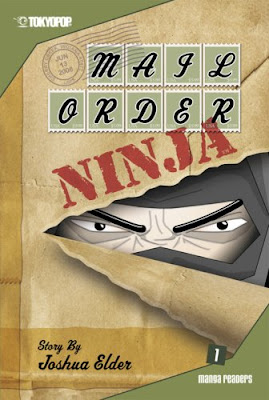
Mail Order Ninja is based on the awesome concept of a young boy, Timmy McAllister, ordering a ninja from a catalogue to help deal with his bully problem. The ninja, Yoshida Jiro, arrives 2-3 weeks later in a crate. He lives with Timmy and his family, obediently following Timmy around like a pet. Timmy is determined to take back the school from the bullies and from Felicity Huntington, the rich and evil student body president. Felicity ends up ordering an army of her own ninjas, which leads to a giant ninja rumble at the school dance.

Simply having a story that involves ninjas beating up bullies should be enough to win over most kids. But Mail Order Ninja also has the added bonus of being very funny. Elder writes with a clever and wacky sense of humour that doesn't dumb down anything for kids. I lost count of the amount of crazy post-modern incidents, such as Timmy reading the very volume of Mail Order Ninja that I was holding. Every character is introduced, Vonnegut-style, with a few quick stats. The books poke fun at everything from youth-focused advertising, to pop music, to the absurdity of school politics. Maybe this is what happens when my generation, the most cynical and over-stimulated, starts writing books; the story is fast-paced and insane and packs in a ton of stuff on every page.

I really like that Timmy's teacher is one of the heroes of the book. Often in books written for kids the teachers are one-dimensional non-characters, or they are the enemy. Ms. Melton is not only one of Timmy's allies, she has a great romance subplot with Jiro.

Elder has a real gift for writing young people. His issue of The Batman Strikes was a lot of fun, and I look forward to more.

Josh Elder was kind enough to do a Q&A with me about the importance of intelligent all-ages comics, writing Batman, and dealing with bullies.

Q: One of my favourite things about Mail Order Ninja is that it has an intelligent sense of humour that doesn't talk down to kids. This seems to be a trend in children's entertainment over the past decade or so (I'd say particularly starting with Disney's One Saturday Morning cartoon line-up from the late nineties). We're seeing it continued in comics like this one and Amelia Rules. When you're writing all-ages books, are you consciously trying to incorporate a "mature" sense of humour into your writing?

The best literature always challenges its readership, and kid lit should be no exception. If anything, kid lit has an added imperative to challenge and educate as well as entertain. Plus, most children's entertainment actually gets consumed by the whole family. Mom and dad deserve a little love too.

For me, the gold standard in children's entertainment has always been "Looney Tunes." Those cartoons are as hilarious to adults as they are to kids, just in an entirely different way, with "What's Opera Doc?" being the perfect example. When I was a youngun', I laughed my little head off at Bugs and Elmer Fudd running around in weird outfits and blonde wigs while singing silly songs. Then I saw it again as an adult and realized that they were parodying Wagner and it was a whole different but equally awesome brand of funny.

We're lucky to be living in a renaissance period for children's entertainment -- everything from Bruce Timm's animated superhero work to Jeff Smith's "Bone" and, of course, "Harry Potter." These are works that will stand the test of time better than most contemporary "adult" literature because they're designed to be accessible to children, but speak to everyone. I'm not operating on nearly that level, but I still try to do the same thing.

Q: One of the criticisms I read somewhere of Mail Order Ninja (and I don't know if this is a common criticism) is that the premise is ridiculous, or at least poorly explained. It struck me that there is something tragic about the modern comic reader's inability to embrace absurdity. In the silver age a story about a kid ordering a ninja out of a catalog would have been downright sensible. Do you feel that there are limits on what a comic writer can get away with these days ? Are you as sad as I am that everyone needs their comics to make sense all the time?

To puree a metaphor: People in spandex houses shouldn't throw stones. At least the premise (Boy orders ninja from catalogue, ninjinx ensue.) of "Mail Order Ninja" doesn't ask anyone to actually take it seriously. Unlike, say, the straight-faced assertion that the Hulk's many, many rampages never generated a single fatality, or that ultra-dense material from a white dwarf star can somehow be engineered into a shrinking device. These critics are encountering my out-there premise as adults rather than children and judging it accordingly while giving equally outrageous superhero conceits a pass because that's what they grew up with. I speak from experience on that one.

However I will concede that the underlying premise doesn't get as fleshed out as it could have been. Thankfully I'm writing a multi-volume series where all those questions will be answered. Other Cherry Creek kids buy their own toys of mass destruction from the JacquesCo catalogue, leading the Federal Trade Commission to order a mass recall of all JacquesCo products which naturally leads to Jiro battling clones of former Presidents Abraham Lincoln and George Washington. So be patient and all questions will be answered in future volumes "How the Ninja Stole Christmas," "All the President's Ninja" and "Mr. Yoshida Goes to Washington."

Q: Now you are writing The Batman Strikes for the Johnny DC all-ages line. Is writing Batman a dream come true for you? How does working with an established character compare to writing your own original characters?

I'm honestly more of a Superman fan -- and I have the "S" shield tattoo to prove it -- but it's still pretty darn awesome to be writing the Dark Knight. I'm contributing to something much bigger than myself and it's both exhilarating and humbling at the same time. Plus everyone knows who Batman is, which really helps in legitimizing my chosen career path to everyone who expected me to be a lawyer or doctor.

As for the differences between writing "Batman Strikes" and "Mail Order Ninja"... It's much easier to write the former than the latter. Thanks to 60+ years of stories, I know what Batman is supposed to sound like and how he would react to any given situation. Heck, I probably know Batman better than I know most of my friends. I'm still trying to figure out all that "interior existence" stuff with the cast of "Mail Order Ninja," which makes it far more difficult process, but also far more rewarding. I'm actually adding something new and ninjarific to the pop culture landscape, and that's awesome beyond words.

Q: Do you feel that writing for Johnny DC is a stepping stone into the "big leagues" or are you perfectly content to write for kids? How important do you feel the Johnny DC line is, relative to the main DC line?

"Wizard of Oz" author L. Frank Baum once said something to the effect that adult literature is very much a product of its time and place and rarely travels beyond those confines, while children's literature knows no such boundaries because children are much the same across the world and across the ages. By writing for children, I drastically increase the potential reach of my work, not to mention its importance. Kids lit matters more than adult fiction because those years matter far more in determining one's character than any other. There have been numerous works that have influenced me as an adult, but none so much as the bible stories I read in Sunday School or the Superman comics I read in kindergarten.

Of course I want to write fiction for adults, too. In fact, I have an adult romantic comedy called "Love Bytes" coming out from Platinum Studios in December. Still, I imagine that a good portion of my career will be spent writing for children and I'm more than okay with that.

As for whether I plan to use "Strikes" as a stepping stone into the mainline DCU... not really. Personally, I think the Johnny DC line should be the main DC line. Streamlined, iconic takes on characters aimed at a younger audience should be DC's principal focus. The endless soap opera that is mainstream comics really doesn't appeal to me and really doesn't appeal to any kind of mass audience either. Superheroes began as a kids lit subgenre, and its foolish beyond belief to abandon that. Not that superheroes can't be used to tell adult stories, but those are few and far between -- and are almost never found in the pages of monthly continuity titles.

To put it another way, "Watchmen" is a mature superhero work that stands next to anything on the fiction shelf at Barnes & Noble. "Identity Crisis" clumsily tries to aproximate that maturity with rapes, murder and morally conflicted protagonists but only succeeds in creating a poorly constructed, juvenile parody of an adult work. Plus "Watchmen" actually has a proper ending, something "Identity Crisis" and pretty much every other mainstream continuity title lacks by design.

Not that I would turn down an offer to write "Action Comics" or anything, I just wouldn't try to tell a story that didn't belong in that venue.

Q: Your issue of The Batman Strikes had a real emphasis on the younger characters - Robin and Batgirl. Was this done consciously, considering the target age of the readers?

Not really, I just really like the dynamic between those two characters on the show. Batgirl is the super-serious older sister while Robin is the bratty younger brother. Their relationship is made even better by their interaction with Batdad in all his stern paternal awesomeness. They're fun to write and (I hope) fun to read as well. I'm a comedy writer by inclination, so I always try to inject as much humor and fun into my stories as possible. Robin and Batgirl let me do that while still keeping Batman all grim and stoic.

Q: Getting back to Mail Order Ninja, what inspired the story? Did you have any personal experience with bullies growing up?

Did I... I had a bit of a weight problem growing up. Not to mention an acne problem and could-only-afford-to-buy-clothes-at-Wal-Mart problem. Not to mention I was on the math team. And played Dungeons & Dragons.

So yeah, I was pretty much the ultimate bully victim until I got to high school and the bullies grew out of most of their jerkitude and I went out for football and got over at least some of my dorkitude. I grew up, basically. Not that a ninja wouldn't have helped matters.

Now the actual genesis of the idea has a fun story behind it. I was a Film major at Northwestern University, and I was trying to come up with an original film short idea. I had just purchased a lot of old comics off ebay filled with mail order ads for sea monkeys, X-ray specs and Charles Atlas fitness regimens. So I thought, "What if you could order something really out there from one of these things, like, say, a ninja." My friends all thought that was the best I'd ever had, and they were right.

Sadly, we soon discovered that hiring a ninja was way beyond our student film budget, so I ended up doing "MON" as a comic. Artist Erich Owen and I entered the original 20 pg short into Tokyopop's 5th Rising Stars of Manga contest, we won the grand prize and the rest is history.

Q: Why did you choose to write Mail Order Ninja in the manga style? Do you have any thoughts about the gravitation of today's youth from traditional American-style comics to manga?

I like manga, and I read a lot of it. It's only natural that it would work its way into my work. The manga invasion has imbued our own cartooning lexicon with a wealth of new visual and storytelling idioms and I'd be foolish not to embrace them. Plus, I'm published by a company called Tokyopop. There are certain expectations of style that go with that.

As for why kids have embraced manga... why wouldn't they? Kids love comics, they really, really do. And these comics are fresh, they're dynamic and adults just don't understand them at all. It's the perfect storm of awesomeness for any kid.

Q: How important is it to make superhero comics accessible to kids again? What comics did you enjoy growing up?

It's extremely important. Kids love superheroes and they love comics. We need to be providing them with plenty of both if we want to have a comic industry 20 years from now. Teaching people how to read comics is just like teaching them how to read any other language -- it's best accomplished when the student is young.

I personally learned to read from comics, and they've been my constant literary companions ever since. Licensed stuff like "Transformers" and "G.I. Joe" plus the standard superhero titles like "Superman," "Batman" and "Amazing Spider-Man."

Q: What are you reading and loving now?

I read so much these days it's hard to narrow it down. I've switched over to trades and graphic novels only, so that helps a bit, but it's still an awful big list. I'll just list a few...

"Amelia Rules" by Jimmy Gownley, basically the second coming of "Peanuts."
"Scott Pilgrim" and I don't think I really need to explain the awesomeness of that one.
"Iron Fist" by Brubaker, Fraction and Aja, basically the best title Marvel has at the moment.
"100 Bullets," "Scalped" and "Criminal." It's a great time to be a crime fan right now.
"Naruto" which is one of the most consistently entertaining books out there. Plus, you know, ninjas!
All things Green Lantern -- Johns is giving us the best era of the character ever.
"All Star Superman" by Morrison and Quitely. Probably the greatest Superman story ever told.
Anything by Jeff Brown.
"Marvel Adventures Avengers" Jeff Parker gives me action, humor and characters I can actually like and respect.
"Fables" by Willingham. Endlessly inventive and willing to change up its status quo on a regular basis.

Q: Who would win in a fight: Yoshida or Batman?

Such a battle would never be fought. They're both smart enough to realize that they're too evenly matched for there to be a clear winner. They'd just team up to fight ninja joker or whatever and then if they really HAD to have it out, they'd settle things over a game of Go or maybe charades.

---

Now that's a game of charades I would like to see!

Thanks, Josh! And I agree...I also know Batman better than I know my friends.

Saturday, September 22, 2007

Q&A with Scott Chantler

The first three chapters of Scott Chantler's really excellent Canadian historical adventure series, Northwest Passage [Oni Press] was recently collected into a beautiful hardcover book. Now he's made the trip from Waterloo, Ontario to Halifax for the Word on the Street festival. I did a Q&A with Scott earlier this week, and now I'm sharing it with you guys.


Q: Are there more installments of Northwest Passage on the way? If so, how many more volumes can we expect?

A: I intend Northwest Passage to be something I return to throughout my career. The story that's collected in the new hardcover was definitely always intended as "season one"...there at least three of four further stories I have in mind for these characters. That said, I'm in no rush to get them out. This first story took two years to complete, and I was eager to step away from it for a while. There a few other projects I want to get to, but there WILL be more Northwest Passage in the future...I just can't tell you precisely when to expect it.

Q: Northwest Passage is an ambitious undertaking! Canadian history is not a popular subject for comic books, or even adventure books in general. What inspired you to write this story, and how much history research was involved?

A: Thanks to Chester Brown's LOUIS RIEL, and my work, Canadian history seems to be becoming a more popular subject every day. But when I first pitched Northwest Passage a few years back, RIEL wasn't out yet, so there was really nothing even remotely like what I was trying to do. Oni Press deserves a lot of credit for having the nerve to take it on. I was first inspired to write something set against Canadian frontier history when I first read Peter C. Newman's COMPANY OF ADVENTURERS and CAESARS OF THE WILDERNESS (the first two parts of his history of the Hudson's Bay Company,) maybe six or seven years ago. I just thought it would make an outstanding setting for an adventure story, and couldn't believe it hadn't been more utilized in that regard. The research was pretty extensive. I had the groundwork with Newman's books, but also devoured as many other sources as I could, books on everything from everyday life at the fur trading posts, to the methods of Cree medicine men, to the history of privateering in Canada. Not to mention websites, old paintings and drawings, museum displays, you name it. Fortunately, I enjoy that part of it. One of the reasons my career has gravitated to historical stories is because I like the process of discovering and learning about new people, places, and times.

Q: How did you get involved with Tek Jansen? What has that been like, in comparison with your previous work? (I read in your blog that Stephen Colbert didn't like your original sketch of him).

People ask me all the time how I got the Tek Jansen gig, and I wish there was a more fascinating answer, but it's really so simple and boring: they called and asked me to do it. I think the guys at Oni Press really wanted to use such a high-profile project to reward some of the people who'd been kicking around there for a while, and I had done five books for them and just come of Northwest Passage. Plus, I think they thought my art style and my "animated" sense of timing would make a good fit for the project. While it was definitely different from the comics work I'd done previously (which was all my personal, creator-owned stuff,) it wasn't really an adjustment to having please a licensor. I do a tonne of commercial illustration work--which is what allows me to take such chances with my choices of comics projects--so I'm used to tailoring a job to a client's wishes. That's how you have to think of these work-for-hire, licensed books...as a job. Might be a really FUN job, but in the end it's somebody else's book, not yours.

Q: Are there issues planned beyond #3 in the Tek Jansen series? If so, will you be involved?

It's planned as a five-issue miniseries. My work actually won't appear beyond the first issue...while it was a great gig to be involved with, I've just had too many offers lately, on my own projects, to have been able to stick with it.

Q: Were you doing cons promoting Tek Jansen at all? What was fan reaction like? Are the fans of that comic different from other comic fans? Lately there have been a few releases that I like to call 'gateway comics' (ie - Marvel's Dark Tower and Anita Blake comics, Dark Horse's Buffy Season 8, and the Tek Jansen series) that seem to attract fans that normally don't read comics. Do you feel that Oni viewed this project as one that might attract new comic readers?

Oni views EVERY project as one that might attract new comic readers. I don't know that there's any publisher in the business who does more to grow the audience. I've done a few shows and signings since Tek hit the stands. It's a little weird to have people coming up who clearly don't know me or my work from a bushel of potatoes...but it helps bring their attention to my creator-owned books. A fan who comes to get their Tek Jansen comic signed might be convinced to pick up a copy of Northwest Passage, too, which is nice.

Q: Were you a fan of Stephen Colbert when you were asked to work on the comic? Were you familiar with his space hero alter-ego?

Yes, I'd been a fan of Colbert's since The Daily Show first started airing in Canada. And while we began work on the comic before the animated Tek Jansen segments began airing on the show, I was always kept aware of what was going on, in terms of being able to see the model sheets and other concept work.

Q: Do you have any other projects you are working on? I know you are working on the relaunch of Hawaiian Dick...

Hawaiian Dick is being relaunched in November as a montly series, with rotating artists. I'm the artist on the first four issues. Other than that, I'm going to be doing two new original graphic novels (both of which I'll be writing) for major publishers. One is something intensely personal, the other something crazy and fun. But that's all I can tell you for now.

Q: You are one of the rare triple threats in the comic industry who pencils, inks and writes. Do you prefer to work this way, or do you enjoy working with other authors and/or artists?

If it's something personal, like Northwest Passage was, I like to do it all myself. I want my hands--and my hands only--on the wheel, and that's the only way to be sure to get it. But I've also really enjoyed the collaborations I've had with others. All of the writers I've worked with have been easygoing, talented, and open to letting me collaborate on the storytelling, which I think is essential. Plus it's just nice to sometimes have someone else to bounce ideas off of, or joke around with...being an auter, while giving you the ability to completely indulge yourself creatively, can be lonely work.

Q: I guess I should ask why you have decided to come to Halifax to participate in the Word on the Street festival. Do you enjoy participating in comic and writers festivals like this one?

I come because they keep inviting me! Plus, I really think the presence of comics and graphic novels at mainstream literary festivals in the last few years has been a blessing--especially for people like myself, whose work isn't in the capes-and-tights vein. Anything that exposes mainstream readers to the diversity and quality of what's being done in comics can only be a good thing...again, it grows the audience. This is the just the kind of festival I like doing the most.

Q: I believe you've been here before. Any thoughts about Halifax? (People here love hearing nice things about Halifax).

My first time in Halifax was Word on the Street last year, in 2006, and I had a blast. Great city, good times, friendly people. I was so glad when the asked me back again.

Q: I'm curious to know if you have any thoughts on the separation of comic book writers from other authors. For example, at this festival J. Torres, Darywn Cooke and yourself are all listed in a subcategory called 'cartoonists,' apart from 'authors,' even though you are all authors. I'm trying to form a question out of this, but all I can come up with is: any thoughts about the status of the comic book writer in the world of authors?

I have no problem at all with the term "cartoonist." It implies someone who writes with pictures, which is a pretty apt description of what I do. I don't think it's meant derisively...at least I don't take it that way. In fact, I think the presence of cartoonists at Word on the Street is a good sign that the literary community has come to (correctly) regard comic and graphic novels as a form of visual literacy.

Q: What does the success of smaller comic publishers such as Oni Press mean for comic creators in terms of what they can offer that larger publishers can't?

Mostly what they offer is freedom. If you want to do your thing, Marvel Comics and DC Comics are not going to let you do that. They want you to draw Spider-man, or Superman, and conform to the editorial direction for those characters, as dictated by the corporations who own them. With a company like Oni, you've got an operation that's run by three guys, which has a lot more opportunity and desire to take risks. Like, say, publishing a story set in Canadian frontier history.

What's been interesting in the last few years is that smaller companies like Oni have been just as successful selling their books in Hollywood as the bigger publishers with more recognizable characters have been. So while the immediate pay-off isn't as great at the smaller companies, there's still the promise of big-time financial rewards.

Q: How do you regard the importance of all-ages comics, and do you feel there are enough being made? (Northwest Passage, for example, could be distributed in schools, but it certainly could have been written with a lot of gore and sex and profanity and still have earned rave reviews, but would have cut out the younger audience). Did you take the younger demographic into consideration when you were writing Northwest Passage, or are you just not a sex and violence kind of guy?

All-ages comics are incredibly important. One of the reasons the '90s was such a dark time in this industry was because comics were so eager to prove themselves as edgy adult reading material that very few people seemed concerned about where the next generation of readers was going to come from. Obviously, that was pretty short-sighted. What's great about the industry as it is today is that there really is something for every age and taste. That's why I think the current buzz around comics and graphic novels is more than just a fad...there are enough good books, and talented creators, to be able to more than hold the public interest.

There's a considerable amount of violence in Northwest Passage, but I tried as much as possible to keep it off-panel, or implied. It wasn't out of consideration for any kind of demographic...I just prefer that sort of Hitchcock-ian style of storytelling, where you make the audience work a bit. You could never show them anything as terrifying as what they can conjure in their own mind.

Q: It seems that more Canadians are making a name for themselves in the comic book industry than ever before. Certainly Toronto has a very strong comic scene, and Halifax has a nice little one for our size. Do you feel that it's a good time to be a Canadian comic creator?

It's a great time. I think Canadians have a distinct voice, and that the industry is becoming more accommodating of distinct voices. You can barely walk down the street in Toronto without bumping into a phenomenally talented comics creator. It's such a great thing to be a part of.

Q: How important is it, to you, for Canadian creators to tell Canadian stories? Obviously Northwest Passage is a Great Canadian history lesson, and has done well in the States. Do you intend to continue to work on books with Canadian themes?

Northwest Passage sells best in Canada, but it does better in the States than anyone had a right to expect. Stong reviews have helped, including prominent reviews in Entertainment Weekly and Publishers Weekly. And it's a big word-of-mouth book. It gets a big boost from blogs, message boards, people giving copies to friends, etc.

I think Canadians are hungry for Canadian stories. It's natural, with the amount of U.S. media we digest, to assume that all stories are set in New York. But when something comes along that's a little more recognizable to us, I think there's a real connection. Something I tried to do with Northwest Passage was to tap into a mythic Canadian landscape. What I've depicted isn't really what northern Manitoba looks like, really...but I didn't want that, anyway. What I wanted was what Canadians see when they close their eyes and think of Canada.

Q: What comics are you reading and excited about right now?

I've been reading my way through Paul Grist's Kane, which I just discovered a couple of years ago but absolutely love. I think Grist may be the most interesting storyteller in comics, currently. There's a European series called Belladone, historical adventure stuff with cartooning which makes wildly jealous. But I don't get as much time to read as I'd like...I'm too busy these days creating my own stuff.


Thanks to Scott Chantler for taking the time to answer my questions!

If anyone local is reading this, come on down to Word on the Street tomorrow! It's free and there are a lot of great writers and artists who will be there. I'll be conducting the Degrassi panel at 1:15 with J. Torres, Ramon Perez and actor Mike Lobel (Jay Hogart from Degrassi The Next Generation). There will also be an 11:15 Q&A with J. Torres on writing for comics, a 3:15 Q&A with Scott Chantler on historical comics, and a 4:15 panel with Darwyn Cooke and Steve McNiven on storytelling and comics. All of these creators, and more, will be available for signings and sketches at various times throughout the day. There's no reason to miss this, and every reason to go!